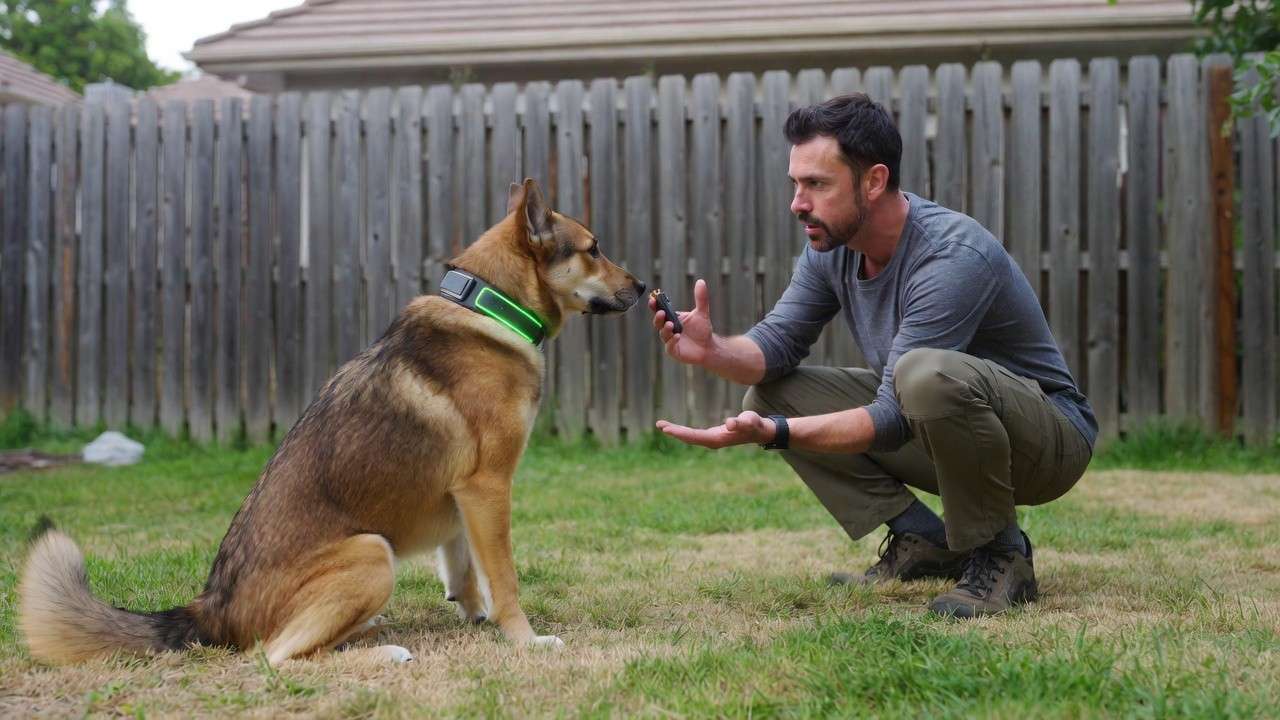
You are at the dog park, frisbee in hand, when your dog suddenly bolts after a squirrel and disappears into the bushes.
You call their name — once, twice — no response.
Then you reach for your phone. The collar vibrates. A few seconds later, your dog comes running back as if nothing happened.
Moments like this make many owners wonder: can smart dog collars replace recall training, or are they simply interrupting behavior without truly teaching it?
Smart collars promise control at a distance. Recall training builds reliability without technology. The difference between those two approaches is more significant than it first appears.
Let’s examine what actually happens beneath the surface.

Introduction: Technology vs Training in Modern Dog Ownership
Modern dog ownership is increasingly reliant on technology. We track steps, monitor sleep, order food with apps — and now we manage our dogs with smart collars.
These collars promise convenience, safety, and control, especially when it comes to recall. Instead of spending weeks practicing “come,” you can simply send a signal and interrupt your dog remotely.
But convenience doesn’t always equal effectiveness.
The Appeal of Smart Collars as a Shortcut
Smart collars are especially attractive to busy owners. They offer GPS tracking, activity monitoring, and remote vibration or tone cues in one device. If your dog wanders off, you can locate them instantly or interrupt their actions with a signal.
For many people, that feels like relief.
A friend once told me her smart collar “saved her sanity” when her energetic Labrador turned every walk into a chase. And that makes sense. These tools reduce stress and give owners a sense of control.
But control and learning are not the same thing.
Why Recall Training Still Matters
Recall training is not just about getting your dog to come back. It teaches your dog to choose you — even when distractions are strong.
A collar may stop a response, but training builds understanding. It creates a habit, an emotional response, and a sense of trust that technology alone cannot provide.
Without that foundation, recall only works when the device works.
How Recall Training Actually Works
Recall training is not about force or commands. It’s about building a positive habit over time.
Recall as Habit-Building, Not Command-Following
Good recall starts in low-distraction environments and slowly becomes more challenging. Each success is rewarded with treats, praise, or play.
Over time, your dog learns that coming to you is always a good thing.
This builds automatic responses, not reluctant obedience.
The Role of Reinforcement and Emotional Association
Positive reinforcement creates emotional value around recall. Your dog doesn’t return because they have to — they return because they want to.
This emotional link is what makes recall reliable even when distractions are strong.
Why Trust Is Central to Recall Reliability
Trust makes recall consistent. When dogs trust that coming back leads to good outcomes, they respond willingly and confidently.
Without trust, recall becomes uncertain or hesitant.
What Smart Dog Collars Really Do
Smart collars are powerful management tools — but they are not learning tools.
They track location, monitor activity, and send signals to interrupt actions. This is useful for safety and supervision.
However, interruption is not education.
Interruption Versus Motivation
A vibration or tone may stop a dog in the moment, but it does not teach them why they should return. Without motivation, recall becomes avoidance-based, not relationship-based.
Why Smart Collars Do Not Replace Recall Training
Learning requires context, repetition, and emotional feedback. Collars provide signals, not meaning.
Dogs may respond to the collar, but they don’t internalize the response the same way they do through training.
This is why many owners eventually ask, Can smart dog collars replace recall training, or can they only manage situations temporarily.
The Response Limits of Technology
Dogs are not machines that simply respond to inputs. They are emotional, context-sensitive decision-makers.
Because of that, any tool that relies only on external signals will always have limits when it comes to shaping reliable responses.
Why Smart Collars Cannot Replace Internal Decision-Making
Recall works best when it is driven by internal motivation rather than external pressure. Training builds that internal decision-making by teaching dogs to choose their owner over competing distractions.
Smart collars, on the other hand, apply external control. They interrupt actions, but they do not teach the dog how to evaluate situations or make good choices on their own.
This means that when the device is removed — or stops working — the response often disappears with it.
In contrast, trained responses remain because they have been internalized.
Lack of Emotional Awareness and Context Sensitivity
Another limitation of technology is that it cannot read emotional or environmental context. A collar cannot tell whether a dog is scared, overstimulated, confused, or anxious.
It delivers the same signal regardless of what the dog is experiencing.
Training, however, naturally adapts to emotion and environment. A dog that has been taught through positive interaction learns not just the command, but also when and why it matters.
This emotional awareness is essential for recall to work in real-life situations, not just controlled ones.
Why Learning Does Not Generalize Through Devices
True learning transfers across environments. A dog that understands recall through training will respond in the backyard, at the park, on a trail, or near a road — because the concept itself has been learned.
With device-based control, the response is often tied to the presence of the tool.
The dog learns to respond to the collar, not to the recall command itself. As a result, recall becomes situational rather than reliable.
Psychological and Training Risks of Over-Reliance
Beyond response limitations, over-reliance on smart collars can also change how owners train — and that shift can weaken recall over time.
The False Sense of Control Technology Creates
Technology can create the feeling that recall is “handled,” which often reduces the owner’s motivation to practice and reinforce the response consistently. When that happens, training gradually fades, and the dog’s recall becomes weaker even though the device is still in use.
This creates a fragile system where recall depends on the tool instead of the relationship.
How Reduced Training Consistency Weakens Recall
Recall depends heavily on repetition and reinforcement. When practice becomes less frequent, habits weaken. When habits weaken, reliability disappears.
The more training is replaced by technology, the more recall becomes a technical response rather than a response-based one.
Dependency Versus Resilience in Dog Responses
Training builds resilience — the ability for a dog to respond correctly even when conditions change. Over-reliance on devices builds dependency, where the dog only responds reliably when the device is present and functioning.
Resilient dogs adapt. Dependent dogs require support to function.
Safety, Reliability, and Failure Scenarios
Technology can enhance safety, but it also introduces new points of failure.
What Happens When Devices Fail
Batteries drain. Signals drop. Apps crash. Hardware malfunctions.
When that happens, only training remains. If recall has not been built independently, the owner has very little control when it matters most.
Why Trained Dogs Remain Safer
A trained dog responds to voice, tone, body language, and routine — none of which require a device to function.
This makes trained recall inherently more reliable in emergencies, unfamiliar locations, or stressful situations.
The Limits of GPS and Remote Correction
GPS is not perfectly accurate. Remote signals cannot adjust to nuance. Human communication can.
That difference matters most when situations become unpredictable — which is exactly when recall matters most.
Smart Collars as Support, Not Replacement
This does not mean smart collars have no value. It means their value lies in support, not substitution.
How Technology Can Enhance Training
When used alongside training, collars can reinforce recall, provide backup control in high-risk environments, and offer useful response data.
Using Collars as Reinforcement and Monitoring Tools
Tracking activity, noticing patterns, and supporting health awareness add meaningful insight without replacing learning.
Where Smart Collars Add Real Value
They are especially helpful for safety, tracking, special needs, and supplemental support — not for replacing the core learning process.
The Human–Dog Relationship Factor
Ultimately, recall is not just a technical skill. It is an expression of the relationship between you and your dog.
The quality of that relationship determines whether recall feels natural and reliable or forced and fragile.
Why Cooperation Matters More Than Control
Dogs learn best when they feel engaged, safe, and involved in the process. Cooperation creates willingness — a dog wants to respond.
Control, by contrast, only produces compliance, which lasts only as long as the pressure remains.
When recall is built through cooperation, the dog sees returning to you as part of the interaction, not as the end of freedom.
Recall as Communication, Not Enforcement
Recall works best when it functions as communication rather than correction. It should feel like an invitation back into connection, not an interruption that shuts the experience down.
When dogs perceive recall as communication, they respond with enthusiasm. When they perceive it as enforcement, they respond with hesitation — or only when they have no other option.
The Role of Trust in Long-Term Reliability
Trust is what turns recall into a habit instead of a negotiation. When a dog trusts that returning to you is safe, positive, and predictable, recall becomes automatic rather than effortful.
This kind of reliability cannot be manufactured by technology. It emerges from consistent, respectful interaction over time.
Decision-Making vs Obedience
Strong recall is not simply obedience. It is the result of good decision-making.
Why Recall Is About Choices, Not Distance
Recall is not defined by how far away your dog is, but by whether they choose you over the alternative. That choice reflects internal priorities, not external pressure.
A dog that chooses to return is demonstrating understanding, not just reaction.
How Emotional Regulation Shapes Recall
Emotional state plays a large role in recall reliability. Overstimulated or anxious dogs struggle to make good choices.
Training supports emotional regulation by teaching dogs how to pause, reorient, and respond thoughtfully.
A calm dog is a responsive dog.
Why Dogs Need Internal Priorities
For recall to remain reliable across different situations, dogs need internal priorities — valuing you more than the distraction in front of them.
External overrides can interrupt responses, but they do not reshape motivation. Only training builds the internal framework that makes recall resilient.
Conclusion: Why Recall Training Remains Irreplaceable
Smart collars can interrupt behavior. Training shapes behavior.
That distinction is the difference between temporary control and lasting reliability.
A recall built through repetition, reinforcement, and trust continues to work when batteries die, signals drop, or devices are removed.
Smart technology is a useful layer of safety — but it is not a substitute for learned response.
The most dependable recall still begins with consistent training, not a vibration alert.
The Smart Pet Gears Team (Team SPG) is a group of pet care researchers, product analysts, and writers dedicated to helping dog owners make informed decisions about smart collars, GPS trackers, and pet technology.
Our articles are based on manufacturer documentation, veterinary guidelines, testing insights, and independent analysis to ensure accuracy and transparency.