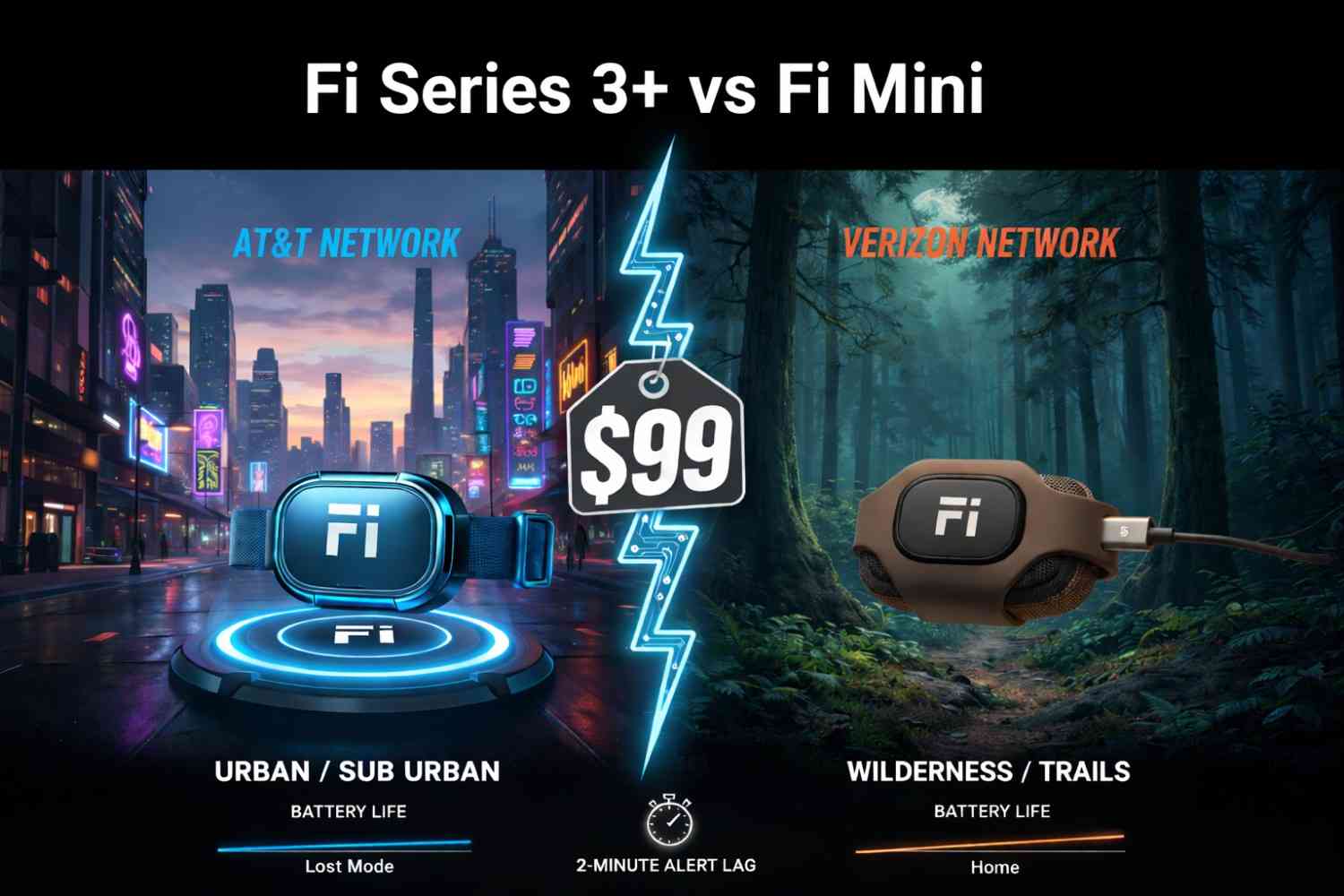
Fi Mini vs 3+ is not really a small-dog vs big-dog decision like marketing suggests.
The real difference comes down to Verizon vs AT&T coverage, battery performance away from home, charging convenience, and how reliably the collar sends escape alerts when your dog gets loose. (Note: Fi Series 3 has been discontinued and replaced by the newer Series 3+.)
The Fi Mini uses Verizon and USB-C charging, making it a stronger fit for travelers and people in Verizon-heavy areas.
The Fi Series 3+ uses AT&T, adds Apple Watch alerts, and works best for suburban households using a home base station.
In this Fi Mini vs 3+ comparison, we test the real-world differences that actually matter: coverage reliability, battery life, alert speed, and subscription costs, not just marketing claims.
Fi Mini vs 3+: Which Should You Buy Right Now?
Before diving deep, here is the blunt decision snapshot many shoppers look for:
(Note: If you are looking for the Fi Series 3, note that Fi currently sells the updated Series 3+. The comparison below applies to both)
| Factor | Fi Series 3+ | Fi Mini | What It Means for You |
|---|---|---|---|
| Target pets | Medium–large dogs | Small dogs & cats | Marketing angle, not the real limiter |
| Cellular network | AT&T | Verizon | Coverage can outweigh dog size |
| Battery at home | Frequent travelers lean towards Mini | Shorter overall | Home-based owners lean 3+ |
| Battery while traveling | Drops faster | More stable | Frequent travelers lean towards Mini |
| Mounting style | Integrated steel collar | Silicone sleeve | Brush-running dogs Favor 3+ |
| Health features | Barking, licking, scratching, Apple Watch alerts | Steps & sleep | Allergy-prone dogs may justify 3+ |
| Charging | Proprietary base | USB-C | Mini is easier on road trips |
| Typical verdict | Best all-around flagship | Niche but powerful traveller option | Depends on lifestyle, not hype |
If you forget the Series 3+ base while traveling, you are effectively stuck until a replacement arrives.
If you lose the Mini cable, you can buy a new one at almost any gas station.
Verizon vs AT&T — The #1 Factor in the Fi Mini vs 3+ Matchup
When people complain that a Fi collar has “no signal,” the issue is usually cellular coverage, not GPS.
- Fi 3+ uses AT&T LTE-M
- Fi Mini uses Verizon LTE-M
If one carrier performs poorly around your home, hiking trails, or travel routes, the collar’s reliability will suffer regardless of features or price.
Before buying, check local carrier coverage and test phones from friends or neighbors in the areas where your dog spends the most time.
In real-world Fi Mini vs 3+ testing, carrier coverage mattered more than dog size.
Important:
If Verizon is significantly stronger where you live, the Mini may be the better choice even for a medium-sized dog.
The reverse is also true for AT&T and the Series 3+.
The Current Fi Trackers Lineup
Fi’s modern ecosystem really revolves around two products.
Fi Series 3+ as the flagship
Series 3+ is the collar Fi pushes hardest. It integrates the tracker directly into a stainless-steel band, adds AI-driven behavior metrics, supports Apple Watch alerts, and uses AT&T’s LTE-M network.
It is also the model for which many existing customers were asked to pay an upgrade fee, which has sparked plenty of debate on owner forums.
Fi Mini as the traveler-friendly alternative
The Mini is a small, puck-style tracker that slips into a silicone sleeve attached to almost any collar. Key features include:
Availability: Access depends on your firmware and subscription tier, but it is actively narrowing the feature gap between the two models.
Network & Sizing: Runs on Verizon’s LTE-M network and is light enough for cats or toy-breed dogs.
Charging: Uses a universal USB-C cable, making it ideal for frequent travel or road trips.
The “Mini+” Update: In late 2025 and early 2026, Fi began rolling out software updates to bring AI-powered barking and eating detection—previously exclusive to the Series 3+—to the Mini.
Trade-offs: The silicone-mounted sleeve can be less rugged in heavy brush, and it still lacks select premium health telemetry.
What About the Older Fi Series 3?
Fi series 3 has been discontinued, but older units still appear on resale sites and remain in use with long-time subscribers.

Which Fi Collar Is Right for You?
When weighing the fi mini vs 3+, choose your model based on your lifestyle and location, not your dog’s size:
Choose the Fi Mini if:
You travel heavily (RV/camping), your area has better Verizon coverage, you want simple USB-C charging, or you want to use your own custom collar.
Choose the Fi Series 3+ if:
You are a suburban homeowner, your area has great AT&T coverage, your dog is a heavy brush-runner, or you want tracking alerts directly on your Apple Watch.
Important:
Fi collars may not perform reliably in deep wilderness or remote off-grid areas because location updates still depend on cellular coverage.
Fi Mini vs Series 3+ Escape Alert Speed Test
One of the biggest questions around Fi accuracy is how quickly the app reacts when a dog leaves a safe zone.
Both Fi Mini & 3+ rely on Bluetooth and Wi-Fi at home, then switch to LTE-M once those connections drop. That handoff is where delays can happen.
In strong conditions, alerts may arrive in under a minute, while weak Wi-Fi or poor LTE coverage can noticeably slow notifications.
That matters because a fast-moving dog can cover several blocks before the first alert appears.
How to reduce alert delays at home:
- Open the Fi app’s System Health screen
- Walk near the edge of your Wi-Fi and Bluetooth coverage
- Watch where the collar switches to LTE
- Reposition the base station if one corner of the yard consistently lags
Series 3+ and Mini behave similarly here because they use the same alert logic.
Fi Coverage Map Explained — Where Series 3+ and Mini Actually Work
Fi advertises nationwide coverage, but real-world performance depends heavily on LTE-M signal strength.
- GPS satellites determine the collar’s location
- Cellular towers determine whether that location reaches your phone
If LTE-M coverage is weak, the collar may still know where your dog is but struggle to transmit updates reliably.
If you’re comparing Fi to non-cellular trackers like Apple AirTag, our Fi vs AirTag comparison explains the key differences in how each tracker reports location.
Suburbs vs Remote Areas
Both collars generally work well in populated suburban areas.
In remote forests, mountains, or deep valleys, coverage gaps become more common because Fi still depends on cellular networks.
This is one reason some hikers prefer Garmin’s radio-based trackers, which can function without cell towers — though they are bulkier and less everyday-friendly.
Verizon vs AT&T Differences
- Fi Series 3+ uses AT&T LTE-M
- Fi Mini uses Verizon LTE-M
In many regions, carrier strength matters more than dog size. A large-dog owner may still prefer the Mini if Verizon coverage is stronger locally, while small-dog owners may benefit more from the Series 3+ in AT&T-dominant areas.
Before buying, check carrier coverage around:
- your home
- hiking trails
- rural roads
- travel routes
Coverage quality often matters more than Fi’s size recommendations.

Fi Mini vs 3+ Battery Life — Real-World Tests
Battery life is one of the most discussed parts of the Fi Mini vs 3+ experience because real-world performance varies heavily by usage.
At home: Fi Series 3+ usually lasts longer because it relies more on the base station than LTE towers.
While traveling: Fi Mini often holds up better since the 3+ drains faster searching for LTE without a nearby base.
Charging: Mini’s USB-C charging is much easier for road trips and power-bank use.
Reality check: Real-world battery life is usually much shorter than the advertised “3-month” estimates.
Typical usage patterns
| Scenario | Series 3+ | Mini | Why |
|---|---|---|---|
| Mostly at home | ~6–8 weeks | ~3–5 weeks | Base station conserves power |
| Daily walks | ~3–5 weeks | ~2–4 weeks | Frequent LTE handoffs |
| Travel without base | ~2–3 weeks | ~2–4 weeks | 3+ searches for network |
| Lost Dog Mode active | 24–48 hours | 3+ searches for the network | Rapid GPS + LTE pings |
Lost Dog Mode deserves special emphasis. Once activated, both collars update location every few seconds. That intensity is lifesaving but brutal on batteries.
Owners effectively have a two-day window before the collar may die, which adds urgency rarely mentioned in marketing copy.
Runner’s Advantage:
Series 3+ owners can trigger Lost Dog Mode directly from an Apple Watch. For runners who leave phones behind, this alone can justify choosing the flagship.
What Fi Really Costs Over Three Years
| Item | Series 3+ | Mini |
|---|---|---|
| Typical hardware kit | ~$150–200 | ~$130–170 |
| 3-year service estimate | ~$350 | ~$310 |
| Approximate total | ~$550 | ~$480 |
Note:
These numbers fluctuate with promotions and membership plans. Always verify current pricing on Fi’s membership page before committing.
Fi subscription cost over time
No matter where you land on the fi mini vs 3+ debate, both models require an ongoing subscription, and over time, service costs will exceed the hardware price.
While hardware pricing changes with promotions, long-term ownership costs matter more when comparing Fi against GPS fence systems like Halo or SpotOn, which use different pricing structures and upfront costs.
For a full breakdown of how Fi compares to other subscription-based trackers, read our Fi vs Tractive guide.
Design, Durability, and Daily Handling
The biggest day-to-day difference between these two trackers is how they physically live on your dog’s neck:
Fi Series 3+ (Integrated Flagship):
The tracker is built directly into a heavy-duty stainless-steel collar band.
It cannot be easily shaken loose, resists up to 400 lbs of pull force, and is designed for rough everyday use — but you are locked into Fi’s collar ecosystem.
Fi Mini (Clip-On Puck):
A tiny, feather-light puck (0.56 oz) that slides into a silicone sleeve and attaches to almost any collar or harness.
It offers far more flexibility, though the silicone-mounted design introduces a small snag or detachment risk in dense brush or heavy woods.
The Fi Series 3 to 3+ Upgrade Trap
The Series 3+ adds AI-powered barking, licking, and scratching detection, plus Apple Watch alerts.
Apple Watch Integration: This is widely considered one of the most useful upgrades. It is a massive perk for runners and active owners who want phone-free access to tracking and Lost Dog Mode.
The Health Metrics: These insights help surface longer-term behavior changes, but false alarms still happen. Routine ear scratching or post-surgery behavior can trigger unnecessary alerts.
Used-Buyer Warning:
Cheap older Series 3 collars on resale sites are not always good deals. In some cases, upgrading older hardware and activating a new membership can cost more than buying a discounted Series 3+ bundle outright.

Are Fi Health Metrics Actually Useful?
Both the Series 3+ and the Fi Mini feature AI-powered behavior insights beyond basic activity tracking
Most owners find the data more useful for spotting long-term behavior changes than for diagnosing specific health problems.
The Benefit: Spikes in restlessness or drops in sleep can warn you about hidden issues (like joint pain or infections) before symptoms show.
The Downside: The AI easily mistakes routine scratching or post-surgery behavior for an emergency, causing false alarms.
Fi vs GPS Fence Systems — What’s the Difference?
Fi collars are primarily GPS trackers, not true containment systems. Unlike GPS fence collars from Halo or SpotOn, Fi focuses more on locating a lost dog after escape rather than preventing the escape itself.
Who Should Skip Both Fi Models
If you live in a total cellular dead zone—deep mountains, remote forests, or backcountry ranch land—neither Fi model is ideal.
In those environments, radio-based systems like the Garmin Alpha line outperform cellular trackers because they do not rely on LTE towers.
Is Fi Worth It in 2026? Final Verdict by Owner Type
So, where does all of this land?
Fi Series 3+ remains the best overall choice for suburban dog owners, especially where AT&T coverage is strong.
It works best for people who keep the collar connected to a home base station and want Apple Watch alerts, stronger health tracking, and a more secure integrated design.
The Fi Mini, meanwhile, is the smarter pick for apartment dwellers, travelers, and anyone living or hiking in Verizon-dominant zones.
Because it uses a standard USB-C charger and fits onto any third-party collar or harness you already own, it is a much more flexible device to live with on a daily basis.
Fi is not ideal for people who regularly venture far beyond cellular networks. In those situations, wilderness-grade trackers remain the safer bet.
The Non-Marketing Summary:
- Buy Fi Series 3+ if you want the most stable home setup, stronger health features, and Apple Watch support.
- Buy Fi Mini if you travel often, prefer USB-C charging, or live in an area where Verizon performs better than AT&T.
- Ignore the “3-month battery” marketing claims for both. In real-world use, most owners charge about once a month.
FREQUENTLY ASKED QUESTIONS
Is Fi Mini better than Fi 3+?
Fi Mini is better for travelers, apartment owners, and Verizon-dominant areas because it uses USB-C charging and Verizon LTE-M. Fi Series 3+ is better for suburban households that want Apple Watch alerts, stronger health tracking, and longer battery life at home.
Does Fi Mini use Verizon or AT&T?
Fi Mini uses Verizon LTE-M, while Fi Series 3+ uses AT&T LTE-M. In many areas, carrier coverage matters more than your dog’s size when choosing between the two.
Is Fi Series 3 discontinued?
Yes. Fi Series 3 has been discontinued and replaced by the newer Fi Series 3+. However, older Series 3 collars still appear on resale sites and remain compatible with some Fi memberships.
Can I use the Fi Mini on a large breed, or is the fi mini vs 3+ decision strictly based on dog size?
Cellular coverage matters more than your dog’s size. The Series 3+ runs on AT&T, while the Mini runs on Verizon. If AT&T is weak locally, choose the Mini—even for a large dog. The only strict size exception is that the Series 3+ is too heavy for dogs under 15 pounds.
The Smart Pet Gears Team (Team SPG) is a group of pet care researchers, product analysts, and writers dedicated to helping dog owners make informed decisions about smart collars, GPS trackers, and pet technology.
Our articles are based on manufacturer documentation, veterinary guidelines, testing insights, and independent analysis to ensure accuracy and transparency.