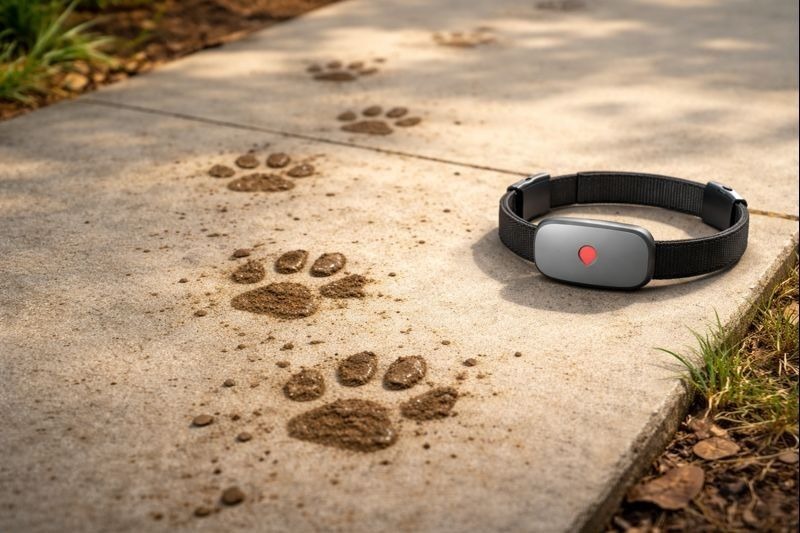
It usually starts with a sound you don’t expect.
A gate clicks.
A door doesn’t latch.
A leash slips from your hand.
Then comes the pause — that half-second where your brain hasn’t caught up yet. You look around. You call their name.
Silence.
In that moment, one thought rises above the panic:
“Thank goodness they’re wearing a GPS collar.”
Or, if they aren’t:
“I should have bought one.”
When something feels chaotic, we reach for certainty. We want a moving dot on a map. We want direction. We want control.
But the real question isn’t whether GPS collars show location. It’s this: do GPS collars help find lost dogs in real escape situations — or do they simply reduce the owner’s uncertainty?
Finding a lost dog is rarely about technology alone. It’s about timing, instinct, environment, and the decisions owners make under stress.
This article looks beyond features and specs. It focuses on the recovery process itself — how dogs behave after they escape, how owners respond, and where GPS genuinely improves outcomes… and where it doesn’t.
The Escape Timeline Most Owners Don’t Think About
Most people imagine a lost dog as a single event. One moment they’re gone, the next moment they’re found.
In reality, escapes unfold in phases. Each phase changes how your dog moves, how they think, and what actually improves your chances of finding them.
Understanding this timeline matters more than any app.
The First 10 Minutes — Confusion vs Pursuit
The first few minutes after an escape are emotionally intense for you. For your dog, they’re mentally unstable in a different way.
Right after escaping, most dogs aren’t “lost” yet. They’re reacting.
Some freeze. They stop just far enough away to assess what changed. Others bolt without direction. A few go into exploration mode, following smells and sounds like they’re on an unexpected adventure.
These reactions usually fall into three patterns:
Freeze:
The dog pauses, hides, or circles nearby. This often happens with timid dogs or those startled by a sudden noise.
Flee:
The dog runs hard and fast, driven by fear or excitement. Fireworks, storms, or loud traffic often trigger this.
Explore:
The dog wanders with curiosity. They sniff, trot, and investigate familiar routes.
Here’s the key detail most owners miss. During this window, your voice, eyesight, and recall training matter more than any GPS signal. Many dogs are recovered in the first ten minutes simply because the owner stayed calm, moved slowly, and didn’t trigger a chase response.
Running after a dog who is already in flight often pushes them farther away.
The First Hour — Movement Patterns Begin
After the initial shock wears off, patterns start to form.
Dogs don’t move randomly. They follow instincts shaped by breed, past experiences, and emotional state.
Some dogs roam in loose circles. They loop back toward familiar smells, homes, or walking routes. Others move in straight lines, covering surprising distances.
Fear-driven dogs often keep moving. Curious dogs pause, sniff, and investigate. Prey-driven dogs may lock onto movement like squirrels, cats, or other dogs.
During this hour, the environment begins to matter more. Busy roads, open fields, wooded trails, and human density all influence where a dog goes next.
This is also when owners often make their first big mistake. Panic kicks in. Instead of observing and planning, they react. They drive randomly. They shout. They refresh an app over and over.
The truth is, the first hour rewards structured action, not frantic movement.
After Several Hours — Survival Mode or Human-Seeking Mode
Once several hours pass, something shifts.
Some dogs enter what looks like survival mode. They avoid people. They hide. They move at night. These dogs are often labelled “hard to catch,” but they aren’t being stubborn. They’re overwhelmed.
Other dogs do the opposite. They seek humans. They approach houses, follow joggers, or linger near food smells.
Why do some dogs come back on their own while others don’t? Experience plays a huge role. Dogs who’ve spent time outdoors alone, even briefly, often navigate better. Dogs who’ve never been unsupervised can become disoriented quickly.
At this stage, recovery becomes less about where the dog is and more about how people interact with the search.
Do GPS Collars Help Find Lost Dogs During Each Phase?
This is where expectations and reality often collide. GPS collars feel like a safety net, but their value changes depending on timing.
Immediate Escape (Minutes After)
In the first few minutes, GPS data rarely beats human senses.
If your dog is within sight or hearing range, stopping to check an app can actually slow you down. Many recoveries happen before GPS data even updates accurately.
GPS can confirm direction, but it doesn’t replace calling calmly, lowering your body, or letting the dog approach you instead of chasing them.
In this phase, technology is secondary. Your response sets the tone.
Short-Term Missing (1–12 Hours)
This is where GPS can help, if used correctly.
A moving location helps narrow search zones. Instead of guessing, you know which blocks, trails, or neighbourhoods matter most.
However, many owners misinterpret the data. A dot on a map doesn’t mean the dog is “right there.” GPS updates lag. Signal bounce happens. Urban buildings distort accuracy.
Some owners follow the dot obsessively, driving past the same area without stopping to ask people or check hiding spots.
GPS works best here when it informs strategy, not replaces it.
Long-Term Missing (24+ Hours)
As time passes, the usefulness often declines.
Batteries die. Collars fall off. Dogs travel through areas with a poor signal. Some dogs settle into hiding patterns that make movement data less useful.
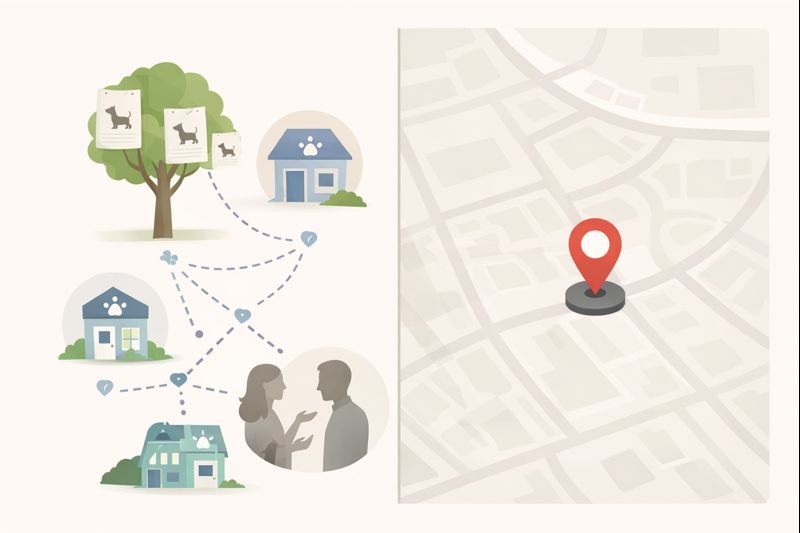
Extended searches depend more on human reporting than tracking. Flyers, shelter notifications, community posts, and word-of-mouth outperform screens over time.
At this point, GPS becomes one input among many, not the lead solution.
Why Some Dogs Are Found Quickly — and Others Aren’t
When two dogs escape under similar circumstances, the outcomes can look wildly different. One is home within an hour. The other disappears for days. To an outsider, it feels random. To someone who understands the patterns, it rarely is.
Recovery speed depends on three forces working together: the dog, the environment, and the human response. When those align, dogs come home quickly. When they don’t, even the best tools struggle to help.
Dog-Specific Factors
Every dog brings their own instincts into the escape.
Breed tendencies matter, but not in the simple way people often assume. A herding dog may circle familiar routes because that’s what they’re wired to do. A scent hound might travel farther, following smells long after visual landmarks disappear.
Companion breeds often surprise owners by approaching strangers sooner, especially when hunger or fatigue sets in.
Age plays a role, too. Younger dogs are more likely to panic and make impulsive decisions. Older dogs, especially those with routine walking routes, often conserve energy and linger near familiar paths.
Experience matters most of all. A dog that has never been alone outdoors doesn’t suddenly gain survival skills when a gate opens. They rely on instinct, and instinct isn’t always efficient.
Dogs with even limited solo exposure tend to orient themselves better, not because they’re smarter, but because their nervous system doesn’t overload as quickly.
These factors don’t determine whether a dog will be found. They influence how the search should unfold.
Environment Specific Factors
Where a dog escapes shapes almost every decision they make afterwards.
In dense urban areas, there are more people, more cameras, and more potential sightings. At the same time, there’s more noise, more traffic, and more confusion.
Dogs can become overwhelmed quickly, darting unpredictably or hiding in tight spaces.
Suburban environments create a different challenge. Streets feel familiar, but witnesses are fewer. Dogs may weave between backyards, disappear behind fences, or stay hidden near their own neighbourhood without ever being seen.
Rural settings stretch searches even further. Fewer human cues mean fewer sightings. Dogs can travel long distances without encountering anyone, especially if prey or livestock draw their attention.
None of these environments is “better” or “worse.” They simply demand different strategies. Problems arise when owners use the same approach everywhere.
Owner Specific Factors
This is the uncomfortable part, but it’s also the most important. The owner’s response often determines how long a dog stays missing.
Speed matters, but speed without direction wastes energy. Owners who pause long enough to observe patterns, coordinate help, and think clearly often outperform those who rush into action, fuelled by panic.
Search quality matters more than effort. Driving randomly feels productive, but it rarely creates sightings. Canvassing methodically, talking to people, and revisiting high-probability areas builds momentum.
Emotional control matters more than technology. Panic narrows attention. Calm widens it.
Dogs are often recovered because an owner made one clear decision at the right moment, not because they did everything at once.
The Search Process Matters More Than the Device
GPS collars promise certainty in uncertain moments. What they actually provide is information. And information only helps when it’s paired with action.
Active Search Beats Passive Tracking Every Time
Watching a dot move across a screen can feel reassuring. It can also quietly replace real searching.
Active searching means getting out of the car. Active searching still depends on skills like recall training, structured walking habits, and owner awareness.
It means checking under porches, calling into yards, and speaking with delivery drivers, joggers, and neighbours. It means turning data into movement, not waiting for movement to appear on your phone.
Why Early Effort Multiplies Over Time
Search effort compounds in ways most people don’t realise.
One poster leads to one call. That call leads to a sighting. That sighting reveals a pattern. That pattern narrows the search area. Suddenly, dozens of people are looking instead of one.
Every hour you wait delays that chain reaction. Every visible action increases the odds that someone remembers seeing your dog later.
This is why dogs are often found days after disappearing, not because the search finally started, but because it finally became visible.
Mistakes Owners Make Without Realising It
Many owners assume their dog will “come back once they calm down.” Sometimes that happens. Often it doesn’t.
Others search everywhere except the places that matter, spreading effort too thin to make an impact.
Perhaps the most common mistake is trusting the app more than the environment. Technology feels authoritative. Human memory feels unreliable. In reality, people notice patterns that GPS cannot.
Psychological Traps That Quietly Reduce Recovery Chances
Losing a dog is emotional. That emotion doesn’t just hurt. It influences decisions in ways that aren’t obvious at the time.
The False Safety of Having GPS
A GPS collar can create a subtle delay response.
Owners feel protected, so urgency softens. Actions are postponed. The assumption becomes, “I’ll act once I have clearer data.”
But early recovery windows don’t wait for clarity. They reward movement.
Panic Creates Motion Without Direction
On the opposite end, panic pushes owners to do everything at once. Calls overlap. Routes repeat. Information gets lost.
Structure disappears, and with it, opportunities.
The goal isn’t to suppress emotion. It’s to stop emotion from choosing a strategy.
How to Actually Use GPS as a Recovery Tool (Not a Comfort Tool)
GPS works best when it informs decisions instead of replacing them.
Interpreting Movement Patterns, Not Just Locations
A dot that isn’t moving doesn’t automatically mean your dog is “right there.” It could mean resting, hiding, or signal drift.
Movement tells a richer story. Direction, speed, and repetition reveal intent. Is your dog looping familiar ground? Moving steadily away? Stopping near structures?
Those answers shape your next move.
Pair GPS With Human Awareness
When talking to people, show your dog’s photo first. Describe their actions. Mention the direction of travel if relevant.
Maps don’t stick in memory. Faces do.
Especially in cities, recovery depends on human recognition far more than satellite precision.
Know When to Change Tactics
There comes a point when following the dot adds no value. Updates lag. Locations repeat. The map stops answering questions.
That’s when canvassing, visibility, and community engagement take over.
Knowing when to switch strategies is a skill. It improves outcomes more than any feature update ever will.
Situations Where GPS Offers Little Real Advantage
Some scenarios overwhelm tracking entirely.
Fear-based flight during fireworks or storms pushes dogs into pure instinct mode. They don’t pause. They don’t orient. They just run.
Intentional removal or theft bypasses the system altogether. Collars are easy to remove.
Dense urban environments distort signals and flood the senses. Data becomes noisy just when clarity matters most.
GPS isn’t broken in these moments. It’s simply outmatched.
So — Does a GPS Smart Collar Actually Help You Find Them?
We’ve walked through the timeline, broken down the stages, and talked about the emotions. Now for the main question: Does a GPS collar really make a difference?
The answer isn’t just yes or no. It’s more about knowing when it helps. Let’s sum up the key points without repeating old ground.
What GPS Is Good At
GPS works best early on. It shows where your dog is during those first few hours. It maps their path to guide your search and can send alerts if they start to wander, giving you time to act before they get far.
In open areas, it acts like a guide, turning large unknowns into clear places to check.
What GPS Is Bad At
GPS struggles during fast escapes. It can be slow, glitchy in bad weather, and useless if someone steals your dog or fear drives them to bolt.
If you rely on it too heavily, you may relax and miss early chances to search. In dense woods or crowds, it offers clues but not precision.
What GPS Cannot Replace
Nothing replaces human effort. Your voice cuts through the noise. Your friends build a safety net. Your instincts help identify hiding spots.
Simple, visible actions—posters, patrols, conversations—still account for the majority of recoveries. Technology supports the process, but you lead it.
Wrapping It Up: You’re the Real Hero in Bringing Your Dog Home
GPS collars can shorten search time and reduce uncertainty, but they do not replace awareness, preparation, or calm decision-making.
The owners who recover their dogs fastest are rarely relying on technology alone. They combine data with visibility, community outreach, and a structured search approach.
A GPS collar is a tool. It can guide you. It can narrow your search. It can reduce panic.
But it does not replace action.
If you rely on one, understand how it works before you need it. Because when an escape happens, clarity matters more than features.
Have you ever recovered a lost dog using GPS? What made the biggest difference — the technology, or the search strategy? Share your experience below.

The Smart Pet Gears Team (Team SPG) is a group of pet care researchers, product analysts, and writers dedicated to helping dog owners make informed decisions about smart collars, GPS trackers, and pet technology.
Our articles are based on manufacturer documentation, veterinary guidelines, testing insights, and independent analysis to ensure accuracy and transparency.