For decades, keeping a dog safely in the yard meant one thing: building a fence. That usually involved, digging trenches, navigating HOA rules, and spending thousands on installation and maintenance.
SpotOn changed that assumption.
Instead of buried wires or physical barriers, SpotOn virtual fence uses GPS technology to create virtual boundaries around your property.
No trenching. No contractors. Just a collar, a smartphone app, and a wireless fence that can be adjusted almost anywhere.
In this Spot On Nova vs Omni review, we’ll take a close look at the two flagship models, the Nova and the Omni Edition, to help you decide which one actually fits your yard, your dog, and your lifestyle in 2026.
Spot On Nova vs Omni: The Quick Verdict
If you are looking for a clear winner in the SpotOn Nova vs Omni matchup, it comes down to your property size and tree density:
Choose the Nova Edition: if you have a yard down to one-third acre, dense tree cover, or want your dog to hear recorded voice commands instead of generic tones.
Choose the Omni Edition: if you have massive acreage (half acre to 100+ acres) with open sky visibility, where ultra-tight GPS precision matters less and the lower price offers better value.
| Feature | Nova Edition | Omni Edition |
|---|---|---|
| Minimum Fence Size | ⅓ acre | ½ acre |
| Accuracy | Less than 5 feet | About 6 feet |
| Satellite Coverage | 151 satellites | 128 satellites |
| GPS Antenna | Dual-band, dual-feed (larger) | Dual-band, dual-feed (original size) |
| Receiver | Dual-feed | Single-feed |
| Battery Life (with Tracking) | 33+ hours | 25+ hours |
| Custom Voice Commands | Yes | No |
| Activity Monitoring | Yes (with heatmaps) | No |
| Cell Reception | Up to 4× stronger | Original |
| Durability | Upgraded housing | Original housing |
Specifications sourced from SpotOn’s official Nova Edition introduction page
SpotOn Nova vs. Omni: The Biggest Differences Breakdown
In the SpotOn Nova vs Omni comparison, both collars are premium GPS fence systems built for different property types.
The Nova focuses on higher GPS precision and smaller-yard usability, while the Omni is better suited for large rural properties and open acreage.
The specs tell part of the story, but real-world performance is what ultimately separates the two models.
Also Read: Halo Collar vs SpotOn Fence: Which GPS Dog Fence Is Better for Your Yard in 2026
Spot On Nova vs Omni Accuracy Comparison
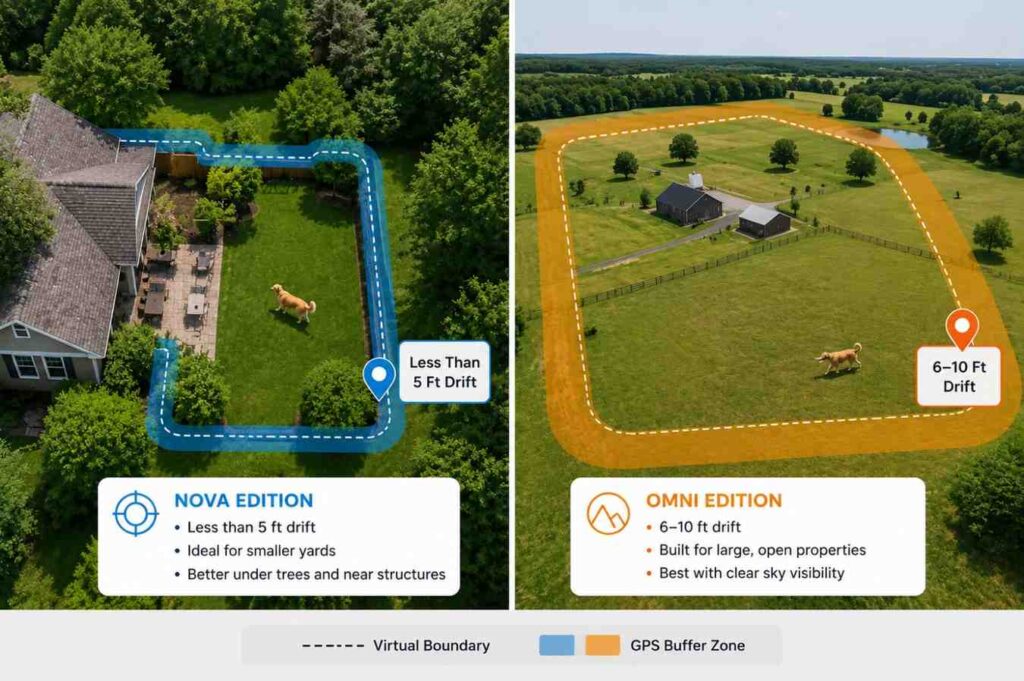
Accuracy is the single most important factor in any GPS fence. If the collar doesn’t know exactly where the dog is, the boundary warnings can come too early—or too late.
Trees, hills, and buildings scatter GPS signals, creating “noise” that can affect boundary accuracy. Here’s how the two collars handle it:
SpotOn Nova: Uses a larger dual-feed antenna and access to 151 satellites. It cross-checks multiple signal sources simultaneously to maintain tighter precision under heavy tree cover.
SpotOn Omni: Uses the original-sized antenna with access to 128 satellites. It still performs well outdoors, but Nova delivers more refined positioning in dense woods and near tall structures.
The “5-Foot” Precision Rule
Nova Precision: Keeps boundary drift under 5 feet. This makes it reliable for tight suburban properties where a few feet mean the difference between your lawn and the sidewalk.
Omni Precision: Experiences a 6-to-10-foot drift range. On a 10-acre field, this buffer is unnoticeable, but it is too wide for a standard neighborhood yard.
That’s one of the main reasons the Nova is marketed toward smaller or more complex properties.
SpotOn Omni vs Nova for Small vs Large Properties
SpotOn Nova: Supports properties as small as one-third acre. Its higher GPS precision allows tighter buffer zones, making it better for suburban and smaller yards.
SpotOn Omni: Works best on properties around half acre or larger, where dogs have more room to move without constantly triggering warnings.
Both systems rely on what trainers call a buffer zone — the space between where warnings begin and the actual fence edge.
Smaller yards require tighter buffer control so dogs have enough time to react and turn back comfortably, which is where Nova’s added precision becomes especially valuable.
Training Features: Tones, Vibration, and Voice
Both SpotOn collars use a progressive training system designed to teach dogs the boundary gradually instead of relying on sudden correction.
SpotOn Nova vs Omni Training Differences
SpotOn Nova includes custom voice commands, allowing your dog to hear familiar phrases like:
- “Back up”
- “Come here”
For many dogs, hearing the owner’s voice can make boundary training feel less stressful and more natural.
Both collars use the same 3-tier warning sequence:
- Tone warning first
- Vibration second
- Static correction only if earlier warnings are ignored
Most dogs quickly learn to respond to the tone alone long before stronger correction becomes necessary.
Battery Endurance and Charging Habits
Battery life is another key difference in the SpotOn Nova vs Omni comparison.
- SpotOn Nova: Rated for roughly 33+ hours of continuous use with tracking enabled. The longer battery life is especially useful for camping, travel, and all-day outdoor use.
- SpotOn Omni: Rated closer to 25+ hours with tracking enabled. It still lasts more than a full day in normal use, but you’ll likely need to recharge it more frequently during extended outdoor trips.
For most home use, both collars perform well. However, Nova’s extra battery margin becomes more valuable during travel or long days away from charging access.
SpotOn Setup and Training Experience
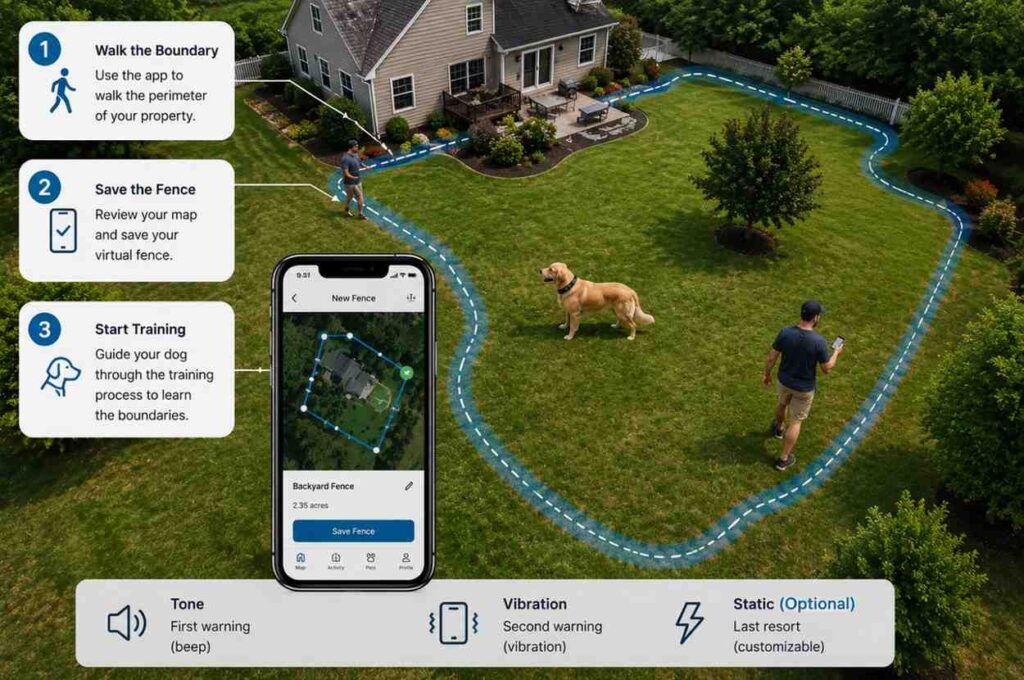
Despite the advanced technology, SpotOn has worked hard to make the setup approachable for everyday dog owners.
Creating Your First Fence
SpotOn lets you create boundaries in two ways:
- Walk the perimeter: Best for irregular yards, wooded properties, and natural landmarks.
- Draw directly on the map: Faster for rectangular yards and properties with clear satellite imagery.
Most owners then test the fence by walking the boundary with the collar to confirm alerts trigger correctly.
Setting Up “Keep-Out Zones”
SpotOn also lets you create smaller exclusion zones inside the main boundary. Owners commonly use them to block:
- gardens
- swimming pools
- driveways
- delivery areas
These zones work like mini internal fences, giving you more control over where your dog can roam..
Training Your Dog: The One-to-Two-Week Commitment
No GPS fence is completely plug-and-play. Most dogs need one to two weeks of guided boundary training before they fully understand the system.
This usually involves:
- walking the boundary on a leash
- teaching the warning tones
- reinforcing where to turn back
Owners who stay consistent during training usually report that their dogs adapt quickly and learn to respect the fence reliably.
Spot On Nova vs Omni Pricing and Long-Term Value
Both collars are premium GPS fence systems, with prices that usually start around $1,000 depending on promotions and tracking plans.
SpotOn Omni: Usually offers better value for large rural properties where ultra-tight accuracy matters less.
SpotOn Nova: Costs more, but adds higher GPS precision, longer battery life, stronger signal handling, and custom voice commands.
Is SpotOn Worth the Cost?
A traditional physical fence can easily cost $10,000 or more once labor, materials, and permits are included. SpotOn avoids:
- trenching
- fence maintenance
- storm repairs
- repainting or replacement costs
For many owners, that makes the long-term value easier to justify
Subscription vs. No Subscription
One of the biggest questions for buyers is the SpotOn subscription cost, and the good news is that you don’t need a plan just to keep your dog in the yard. The containment features work entirely offline once the boundary is stored on the collar.
You only need a plan for:
- live GPS tracking
- cellular connectivity
- escape alerts
Owners with escape-prone dogs may find those features worthwhile, while many others use the collars without ongoing monthly fees.
While comparing five-year ownership costs, systems with mandatory monthly plans often end up far more expensive than SpotOn, even if their upfront hardware price is lower.
| System Type | Hardware Cost | Monthly Fee | 5-Year Subscription Total | 5-Year Total Cost |
|---|---|---|---|---|
| SpotOn (No Plan) | $999 | $0 | $0 | $999 |
| SpotOn + Tracking | $999 | $10 | $600 | $1,599 |
| Competitor w/ Required Plan | $700 | $30 | $1,800 | $2,500 |
Figures are estimates based on publicly advertised pricing at the time of writing; actual costs vary by plan, promotions, and region.
Who Should Buy Which SpotOn Model?
Choose SpotOn Nova If:
- You have a smaller or suburban yard
- Your property has dense tree cover
- Boundaries run close to sidewalks or neighbors
- You want maximum GPS precision
- Longer battery life and voice commands matter to you
Nova is usually the better choice for tighter or more complex property layouts where GPS accuracy matters most.
Choose SpotOn Omni If:
- you own large open acreage
- your property has clear sky visibility
- you want reliable containment without paying for extra precision features
- you have farms, ranches, or wide rural land
Omni remains a strong value-focused option for large properties where ultra-tight boundary accuracy is less important.
Before choosing between Nova and Omni, it’s worth understanding how the overall SpotOn system works.
Any SpotOn Fence review ultimately comes down to three factors: GPS accuracy, training reliability, and how well the virtual boundary performs in everyday conditions.
How SpotOn Virtual Fence Work
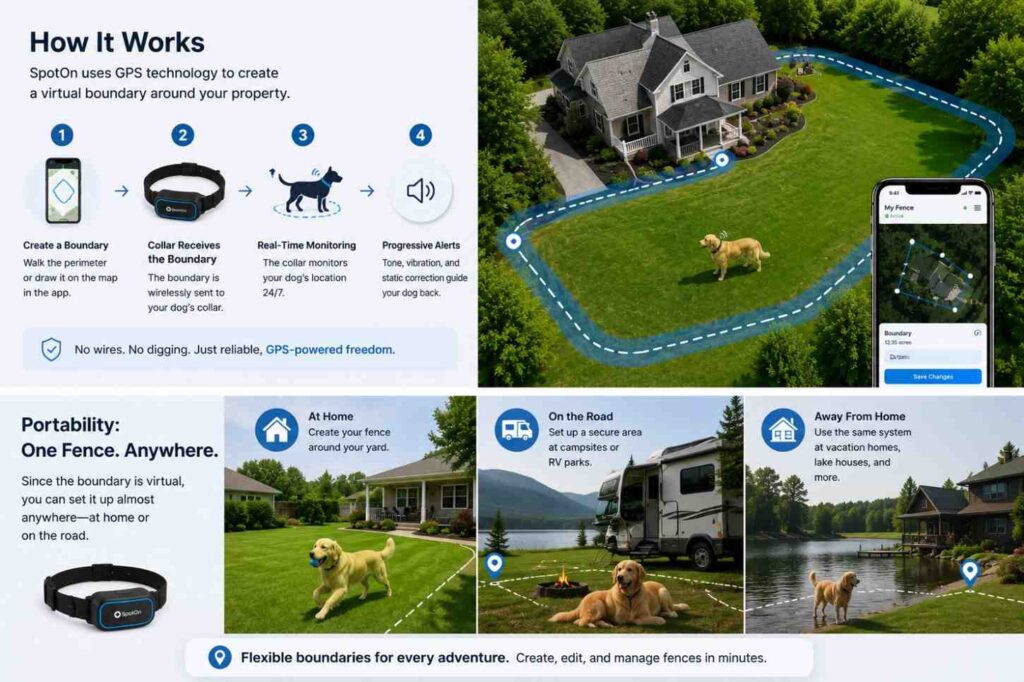
Traditional invisible fences require buried wires that can break, shift, or become difficult to modify over time. SpotOn replaces those physical boundaries with virtual GPS-based fences created directly through the mobile app.
Creating a Virtual Fence
You can set up a SpotOn boundary in two ways:
- walk the perimeter of your property with the collar and phone
- draw the fence directly on the in-app satellite map
This flexibility makes the system much easier to customize for irregular yards, wooded lots, farms, and large rural properties.
Once the boundary is saved, the collar continuously checks your dog’s real-time position against the virtual fence. As your dog approaches the edge, the system automatically begins a progressive warning sequence:
- alert tone
- warning tone or Nova’s custom voice prompt
- optional static correction if needed
Because there are no buried wires, changing the fence layout takes only a few minutes inside the app. Owners can easily expand boundaries, shrink them, or create internal “Keep-Out Zones” for pools, gardens, and driveways.
Portability: Taking Your Fence on the Road
One of the biggest advantages of the SpotOn Virtual Fence is portability. Since the system runs entirely through the collar and app, you can quickly create temporary boundaries almost anywhere.
Owners commonly use portable fences for:
- camping trips
- RV parks
- vacation homes
- lake houses
- large family properties
That flexibility allows dogs to enjoy off-leash freedom without needing permanent fencing installed at every location.omized safety perimeters while camping, visiting family, or staying at an RV park.
Who This SpotOn Fence Is Not For
This system may not be the best fit for owners with very small or narrow yards where there isn’t enough space for safe buffer zones, or for properties that sit directly beside busy roads.
It’s also not ideal if you’re unwilling to commit time to proper boundary training or if you don’t want to manage regular collar charging.
SpotOn Virtual Fence Pros and Cons
| Pros (The Good News for Dog Owners) | Cons (What to Watch Out For) |
| Total Portability: The fence lives in the collar—use it at home, while camping, or at vacation rentals. No wires ever. | High Upfront Cost: Around $999, which is a serious initial investment. |
| No Mandatory Subscription: Core containment works without monthly fees, saving money long-term. | Training Required: Expect 1–2 weeks of structured boundary training. |
| Performs Well in Woods: Advanced antennas—especially on the Nova—maintain accuracy under tree cover. | Possible GPS Drift: Boundaries can shift a few feet daily due to satellite conditions, which matters near roads or tight lots. |
| Highly Customizable Boundaries: Create any shape plus interior “Keep-Out Zones” for gardens or pools. | Not for Very Small Yards: Narrow or city properties may not meet space requirements. |
| Waterproof & Rugged: IP67-rated for swimming and harsh weather. | Regular Charging Needed: Daily charging with tracking enabled is common. |
| Strong Customer Support: U.S.-based help and free training sessions get frequent praise. | Tracking Costs Extra: Live location sharing and escape alerts require an optional cellular plan. |
Conclusion: Spot On Nova vs Omni — Which Offers True Freedom?
For many dog owners, SpotOn represents a shift away from permanent, expensive fencing toward something far more flexible.
The peace of mind that comes from knowing your dog can roam safely, whether at home or on the road, is what ultimately sells most people.
Between the two models, the Nova stands out as the best all-around choice in 2026, especially for suburban or wooded properties.
The Omni still holds its place as a capable, cost-effective solution for owners with massive acreage.
Overall, this SpotOn Fence review finds that both the Nova and Omni deliver reliable GPS containment, with the best choice depending primarily on your property’s size and environment.
Frequently Asked Questions
What happens if I lose the GPS signal?
If the collar temporarily can’t confirm its location, it defaults to safety protocols and alerts you through the app if you’re using a subscription plan. Signals usually recover quickly once satellite visibility improves.
Can I use it for two dogs?
Yes. You can add multiple collars to the same boundary, and SpotOn typically offers discounts when purchasing additional collars for multi-dog households.
Is the static correction safe?
When used properly and paired with training, the static stimulation is designed to be humane and adjustable. Most dogs learn to respond to the tone or vibration long before the higher levels are ever needed.
Is SpotOn Nova more accurate than Omni?
Yes. SpotOn Nova offers tighter GPS precision than Omni, especially in wooded areas, near buildings, and on smaller properties where boundary accuracy matters most.
Always follow manufacturer training guidance and consult a veterinarian or trainer for sensitive dogs.
The Smart Pet Gears Team (Team SPG) is a group of pet care researchers, product analysts, and writers dedicated to helping dog owners make informed decisions about smart collars, GPS trackers, and pet technology.
Our articles are based on manufacturer documentation, veterinary guidelines, testing insights, and independent analysis to ensure accuracy and transparency.