GPS dog collar accuracy indoors is a common concern for people who rely on tracking devices for everyday peace of mind, only to feel confused when the neat moving dot on their phone suddenly drifts across the screen after their dog walks into the house.
One moment, the location looks precise, and the next, it appears stuck in the wrong room or floating somewhere near the driveway. That shift can spark worry, especially when the technology works so well outside.
In reality, this behavior is rarely a sign that something is broken. Indoor spaces create a very different environment for satellite signals than open yards or parks do. Walls, roofs, furniture, and even a building’s layout can interfere with how a collar listens for location data and sends it back to an app.
This article will walk you through the main reasons accuracy drops indoors, how different home layouts affect tracking, what backup systems try to do, and what you can realistically expect from your device.
Along the way, you will see everyday examples that make the science easier to picture and practical insights that reflect real-world use.
How GPS Dog Collars Normally Find Location
Before diving into indoor problems, it is useful to know what happens when tracking works well outside.
A GPS collar listens for signals sent from satellites circling the planet. By measuring how long those signals take to reach the collar, the device can calculate where it is on Earth.
When the sky is open, and nothing blocks the view, several satellites can be “seen” at once. That gives the collar enough information to place your dog with impressive accuracy, sometimes within a few feet.
Most modern collars also send that location to your phone through a cellular network. Some even combine satellite data with nearby Wi-Fi signals to keep the map updated smoothly. Outdoors, all of these systems usually cooperate nicely.
Once your dog walks through the front door, however, the environment changes in a big way.
Why Indoor Spaces Are Hard for GPS
Several physical and technical factors inside buildings interfere with satellite tracking, and understanding these makes sudden location jumps feel far less mysterious.
Walls and Roofs Weaken Satellite Signals
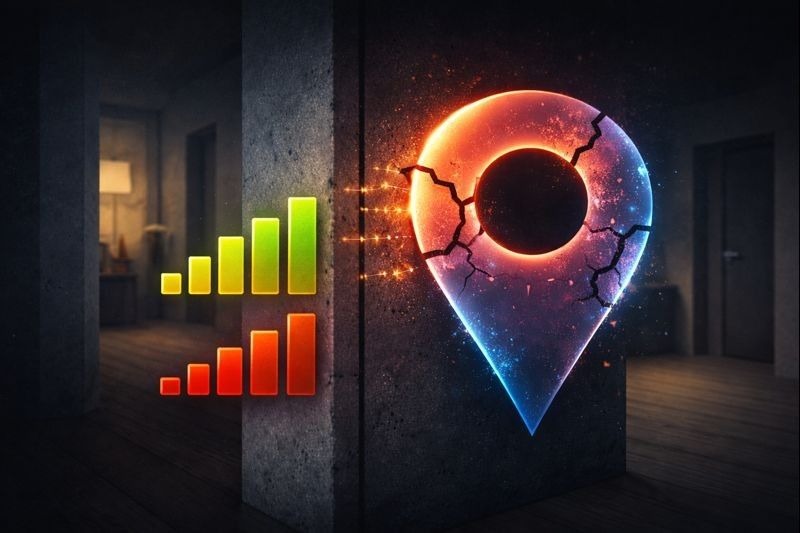
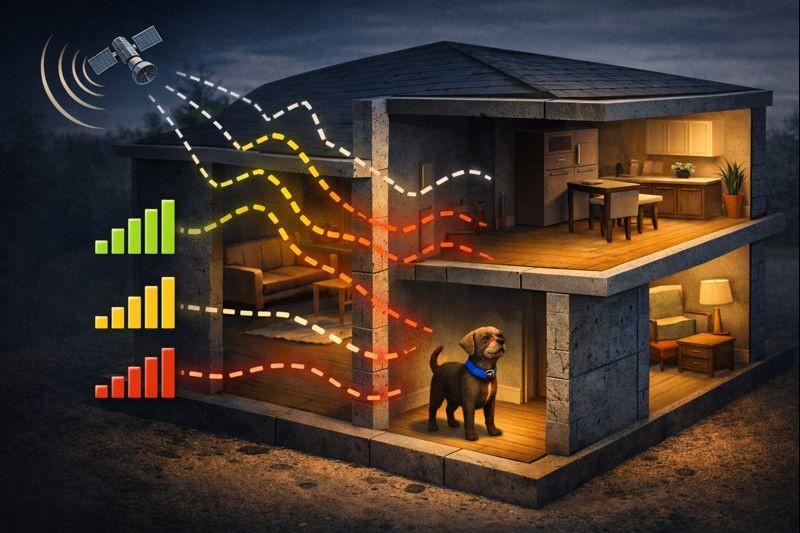
GPS signals are incredibly faint by the time they reach the ground. They travel from space, after all. Outdoors, they have a clear path to the collar. Indoors, those same signals must push through roofs, walls, ceilings, and sometimes several floors of building material.
Concrete, brick, stone, and metal are especially tough obstacles. A house with thick walls or a metal roof can weaken the signal so much that the collar struggles to hear it at all. Apartment buildings and offices are even trickier, since multiple layers of structure sit between the collar and the sky.
Think of it like trying to listen to someone speaking softly outside while you are in a closed room with the windows shut. You might catch parts of the message, but not enough to understand every word clearly.
Signals Bounce Around Inside Buildings
Even when some satellite signals sneak indoors, they often take strange paths to get there. Instead of traveling straight to the collar, they can bounce off walls, ceilings, large appliances, and metal furniture.
These little detours matter because GPS relies on timing. If a signal arrives even a tiny fraction of a second later than expected, the collar may think it traveled farther than it actually did. That can shift the reported location across the map.
This is why your app might suddenly show your dog in the driveway while the animal is curled up under the dining table. The collar is not lying; it is simply working with distorted information.
Fewer Satellites Are Available Indoors
Outside in an open yard or park, a collar can usually hear many satellites at once. Indoors, only a handful might get through the building, and sometimes none come through clearly enough to be useful.
With fewer satellites to work with, the collar has less data to build an exact position. The system becomes less confident, and the error range grows. Updates may slow down, and the dot on the map can start wandering in small circles or freeze until better signals appear.
If your dog moves closer to a window or door, accuracy may suddenly improve for a moment. Step deeper into the house, and the signal may fade again. Many people notice this pattern without realizing why it happens.
Home Design Plays a Role
Beyond general signal loss, the way a home is built can dramatically shape how well a collar performs once a dog goes inside.
How Home Construction Affects GPS Dog Collar Accuracy Indoors
A single-story home with wood framing and large windows is usually friendlier to GPS than a tall apartment building made of concrete and steel. In a small house, some signals may pass through the roof or walls just well enough to keep tracking semi-stably.
In high-rise buildings, the collar might be buried beneath several floors of dense material. That makes satellite contact much harder, and indoor accuracy can drop sharply.
Basements and underground garages are among the toughest places for GPS to function. Being below ground adds another barrier that weakens signals even further.
Metal and Energy-Efficient Materials
Modern construction sometimes uses metal beams, reflective insulation, or special energy-saving windows designed to keep heat in or out. While great for comfort and utility bills, these features can reflect or block radio signals, including those used for GPS.
If your home has this type of design, you may notice more indoor drift than someone living in an older building with lighter materials.
What Happens When GPS Fades
When satellite contact weakens, collars rely on other methods and internal safeguards that change how updates appear in the app.
Switching to Backup Systems
Many collars are built with more than just satellite tracking. When GPS becomes unreliable, the device may lean on nearby Wi-Fi networks or cellular towers to guess where your dog is.
Wi-Fi-based positioning works by comparing visible routers to large databases that store their usual locations. If your house and neighborhood are well-mapped, this can give a rough idea of where the collar is sitting. Cellular methods look at the distance from cell towers and estimate a position from there.
These systems are helpful, but they are not as sharp as true GPS. Wi-Fi records may be outdated, and cell towers cover wide areas. That is why indoor locations can be off by a noticeable amount even when the app still shows something on the map.
Slower Updates and Frozen Dots
When a collar struggles to get a clean signal, it may take longer to confirm each new position. Instead of refreshing every few seconds, it might update only once in a while. During that gap, your dog could wander into another room while the dot on your phone stays put.
Some collars are also designed to save battery when movement is low, which often happens indoors. They may reduce how often they check the location until motion increases again. From the user’s point of view, that can look like the tracker has stalled, even though it is simply being conservative with power.
Real-World Examples You Might Notice
Everyday household situations often reveal indoor GPS limits more clearly than technical explanations ever could.
The Couch Mystery
Imagine your dog naps in the living room for an hour. You glance at the app and see the marker drifting slowly toward the edge of the property, then jumping back again.
Nothing spooky is going on. The collar is just switching between weak satellite signals, Wi-Fi guesses, and short gaps where it has no solid data.
The Window Effect
You might also notice that accuracy improves when your dog lies near a sliding glass door or sits by a large window. Glass blocks signals less than thick walls, so the collar suddenly hears more satellites. Move away from that spot, and the map becomes fuzzy again.
Does Collar Placement Matter Indoors?
Even with the same home and tracker, how the device sits on your dog can quietly influence reception from room to room.
Fur, Fit, and Body Position
The way a collar sits on your dog’s neck can make a difference, especially indoors, where signals are already weak. If the device is tucked under thick fur, pressed tightly against the body, or rotated so the antenna faces inward, reception can drop a little more.
When a dog curls up on a bed or squeezes behind furniture, the collar may be shielded by cushions, walls, or even the dog’s own body. All of that adds up to poorer signal quality.
Movement Through the House
As your dog walks from room to room, the signal environment changes constantly. One room might be closer to an outside wall, another closer to the center of the house.
Each step can alter how many satellites the collar can hear. That is why indoor tracks sometimes look jagged or scattered rather than smooth.
Is Something Wrong With the Collar?
Indoor drift usually reflects normal system limits, but there are moments when poor performance can hint at a real issue.
Normal Limits Versus True Problems
Most of the time, indoor inaccuracy does not mean your collar is faulty. It reflects the limits of satellite technology in enclosed spaces. Nearly every brand on the market faces the same challenge.
That said, there are situations where performance may be worse than expected. A damaged antenna, outdated software, or a weak cellular connection in your area can add to the trouble.
If your collar struggles even outdoors in open spaces, that is when it makes sense to check settings, update the app, or contact support.
What Accuracy Should You Expect Indoors?
Knowing the typical range of indoor error helps set expectations and prevents panic when the map does not line up with reality.
A General Rule of Thumb
Inside a typical home, many GPS dog collars shift from very precise outdoor tracking to rough estimates. The position might be off by several yards, or sometimes more, in dense buildings. Refresh rates can slow, and the app may rely heavily on Wi-Fi or cellular guesses.
Once your dog steps back outside with a clear view of the sky, accuracy usually snaps back quickly. Within seconds or a minute, the map often tightens again as satellite contact improves.
Can Anything Improve Indoor Performance?
While no fix can make GPS perfect inside buildings, a few practical steps can reduce confusion and improve reliability.
Keeping Software Updated
Manufacturers regularly fine-tune how collars blend GPS, Wi-Fi, and cellular data. Keeping both the collar firmware and phone app updated ensures you are getting the best version of those improvements.
Strong Home Wi-Fi
If your collar uses Wi-Fi positioning, having stable home internet and properly set-up routers can help slightly with indoor estimates. It will not turn indoor tracking into pinpoint GPS, but it may reduce wild jumps.
Realistic Expectations
Perhaps the most important adjustment is mental rather than technical. GPS dog collars shine outdoors. They are built for yards, trails, parks, and neighborhoods.
Indoors, they become more of a general presence indicator than a room-by-room locator. Understanding that difference can save a lot of worry.
When Indoor Tracking Still Has Value
Even with all these limits, indoor data is not useless. It can still tell you whether your dog is likely to be at home or somewhere else.
If the collar suddenly updates far down the street, that is meaningful. If it floats around your address, you can assume your companion is probably inside, even if the exact room is unclear.
For many families, that broad reassurance is enough until the dog heads back outdoors and the map sharpens again.
The Bigger Picture
GPS technology was originally designed for open skies, not living rooms and stairwells. Walls weaken signals, reflections confuse timing, fewer satellites are available, and backup systems are less precise.
Add battery-saving features and changing collar positions, and it becomes clear why indoor accuracy drops.
GPS systems were engineered for open environments. Inside buildings, signals weaken, reflect, and drop below reliable thresholds.
As a result, indoor accuracy becomes approximate rather than precise. That shift is inherent to satellite tracking and affects all consumer GPS collars similarly.
The Smart Pet Gears Team (Team SPG) is a group of pet care researchers, product analysts, and writers dedicated to helping dog owners make informed decisions about smart collars, GPS trackers, and pet technology.
Our articles are based on manufacturer documentation, veterinary guidelines, testing insights, and independent analysis to ensure accuracy and transparency.