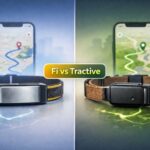
When people first open a GPS tracking app for their dog, they usually expect one simple thing. They expect to see their dog’s exact location appear instantly on the screen, just like dropping a pin on a map.
Sometimes that does not happen. The dot may take a few seconds to load. Sometimes it appears slightly off. Other times, it seems to lag where the dog actually is.
Many misunderstandings come from not knowing how GPS dog collars work in real life, especially when expectations are shaped by apps and marketing rather than the actual system behind the tracking.
GPS dog collars are often criticized for being inaccurate or unreliable, but in most cases, they are performing exactly as intended.
The issue is not failure. The problem is misunderstanding how the system works.
This article explains what is really happening behind the scenes. It focuses on how GPS dog collars determine location, how that information travels, and why results look the way they do in real life.
What a GPS Dog Collar Is Built to Do
At its core, a GPS dog collar has one primary job. It figures out where it is and reports that location to a connected system. Everything else flows from that single purpose.
The collar does not watch the dog. It does not think or predict behavior. It does not actively guide movement.
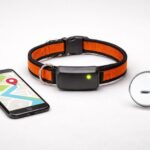
GPS dog collars work by using satellite signals to calculate a dog’s location and cellular networks to send that location to a mobile app. The collar estimates its position based on available signals and updates it at intervals, which is why tracking is not always instant or perfectly precise.
Understanding this narrow function matters because it sets the boundary for what the device can and cannot do.
When people expect more than location reporting, disappointment follows. When people understand the actual role of the collar, its behavior starts to make sense.
The Problem GPS Dog Collars Are Designed to Solve
GPS dog collars exist to solve one specific problem: locating a moving dog over distance without relying on line of sight.
Traditional visual tracking fails the moment a dog disappears around a corner, into trees, or over terrain. GPS tracking removes that limitation by using signals that travel far beyond what the human eye can see.
Instead of following the dog physically, the collar follows its position digitally. That shift is powerful, but it also introduces delays, estimation, and dependency on signals that do not always behave perfectly.
The collar does not magically know where the dog is at every second. It calculates location based on what it can detect at the moment.
What GPS Dog Collars Are Not Designed to Do
GPS dog collars are not designed to provide constant, uninterrupted precision. They do not stream location like a live video feed.
They do not override environmental interference. They also do not function independently of signal conditions.
Once these limits are clear, the rest of the system becomes easier to understand. What may feel like inconsistency is often the result of predictable technical behavior.
How a GPS Dog Collar Determines Location
To understand how GPS dog collars work, it helps to start at the very beginning. Location does not come from the app. It does not come from the phone. It starts with signals in the sky.
How GPS Satellites Help the Collar Calculate Position
GPS satellites constantly send signals down toward the Earth. These signals contain timing information that allows receivers to estimate distance. A GPS dog collar includes a small receiver that listens for these signals.
When the collar picks up signals from multiple satellites, it compares how long each signal took to arrive.
Based on those differences, it estimates its position on the Earth’s surface. This process does not produce a single perfect point. Instead, it produces an estimated area where the collar is likely located.
This calculation takes time. The collar must first detect signals, then process them, and then confirm enough data to form a location estimate. If signals are weak or partially blocked, the estimate becomes less precise or takes longer to form.
Why GPS Alone Cannot Show Location on Your Phone
At this stage, the collar knows where it is, but only locally. That information exists inside the device itself. GPS satellites do not send location data to phones. They only send signals downward.
For the location to appear on your phone, the collar must send that information outward through another system.
This separation between knowing location and sharing location is critical to understanding delays and gaps.
How Location Data Travels From Collar to App
Once the collar calculates its position, it still has more work to do. The data must travel from the collar to your screen, and that journey involves multiple steps.
The Role of Cellular Networks in GPS Tracking
GPS dog collars rely on cellular networks to transmit location data. After calculating its position, the collar sends that information through a mobile signal, similar to how a phone sends data.
If the collar cannot connect to a cellular network, the location stays inside the device. The collar may still know where it is, but it cannot share that information in real time.
This is why GPS tracking depends not only on satellites but also on network availability.
What Happens Between the Collar and the App
The data does not go straight from the collar to the phone. Instead, it usually travels from the collar to a server, where it is processed and stored. From there, the app retrieves the most recent available location.
This layered system explains why refreshing the app does not force the collar to update. The app can only display what the system has already received.
Why GPS Location Is Not Always Instant
One of the most common frustrations with GPS dog collars is delay. People expect instant updates, but that expectation does not match how the system operates.
Why Location Updates Take Time
First, the collar must detect satellite signals. Then it must calculate the location. After that, it must connect to a cellular network and send the data. Each step introduces small delays. When combined, those delays become noticeable.
If signal conditions are poor, any one of these steps can slow down. The system does not skip steps. It waits until it has enough information to report a location.
Why Refreshing the App Does Not Force a New Location
Refreshing the app only reloads existing data. It does not trigger the collar to perform a new calculation. The collar operates on its own schedule based on system rules, not user actions.
That’s why delays happen.
How GPS Dog Collars Decide When to Update Location
GPS dog collars do not update location continuously. Instead, they follow defined intervals that balance accuracy with system limitations.
What “Live Tracking” Actually Represents
When people see the term live tracking, they often imagine constant movement on the map. In reality, live tracking means frequent updates, not continuous ones. The collar checks the position, sends data, and then repeats the process after a short pause.
The movement between updates is inferred, not directly tracked. This is why motion can appear smooth or jumpy depending on update timing.
Why GPS Collars Update in Intervals
Frequent updates require more power and more data transmission. To manage this, collars space out updates based on internal logic.
This approach allows the system to function longer without overwhelming power or network resources.
Intervals are not flaws. They are design decisions.
Why GPS Locations Sometimes Appear Wrong
When a location dot jumps or drifts, it often looks like an error. In reality, it is usually the result of changing signal conditions.
How Environmental Obstacles Affect GPS Signals
Trees, buildings, hills, and even weather can weaken or block satellite signals. When signals become inconsistent, the collar must work with partial information. This leads to broader estimates rather than precise points.
The collar does not guess randomly. It recalculates based on what it can detect at that moment.
Why the Location Marker Can Drift or Jump
If the collar temporarily loses signal and then reconnects, the next location update may appear far from the previous one. This location drift usually reflects a signal correction, not a sudden movement.
GPS Accuracy in Practical Terms
Accuracy is often misunderstood as perfection. In GPS tracking, accuracy means closeness, not exactness.
What GPS Accuracy Looks Like Outside of Marketing
In real-world conditions, GPS locations represent an area, not a dot. The system shows the best estimate based on available data. This estimate changes as signals improve or degrade.
Expecting pinpoint precision ignores how the technology works.
Why Accuracy Varies by Environment
Open areas allow stronger signals and better calculations. Dense environments introduce reflections and blockage. The system responds accordingly by adjusting estimates.
The collar behaves consistently. The environment changes.
How Battery Power Directly Affects Tracking Behavior
Every part of GPS tracking consumes energy. From listening for satellites to sending data, power drives performance.
Why GPS Tracking Consumes So Much Power
The collar must remain alert to signals and ready to transmit. This constant readiness uses energy even when the dog is not moving. Unlike simple devices, GPS collars operate continuously.
What Changes as Battery Levels Drop
As power decreases, the system may reduce update frequency or delay transmissions. These changes preserve core function rather than shutting the system down entirely.
How Movement Changes GPS Tracking Results
Movement adds another layer of complexity to location tracking.
Slow Movement vs Continuous Motion
When movement is gradual, updates align more closely with visible position. When movement is continuous, the system captures snapshots rather than a full path.
Fast Movement and Location Lag
At higher speeds, the collar may report where the dog was moments ago rather than where it is now. This lag reflects update timing, not failure.
Where GPS Tracking Systems Break Down
No system works everywhere. Every tech has weak points, and GPS collars falter in predictable ways.
Why GPS Performs Poorly Indoors
Satellite signals struggle to penetrate buildings. Without clear signal paths, location calculation becomes unreliable.
Why Network Coverage Limits Tracking
Even with GPS data, a location cannot travel without network access. The system requires both components to function fully.
Final Thoughts: Understanding the System Explains the Results
Most performance complaints stem from a misunderstanding of update intervals and signal dependency. GPS collars calculate position from satellite timing, transmit it through cellular networks, and update at defined intervals rather than continuously.
Delays, drift, and lag are operational characteristics of that system—not malfunctions.
The Smart Pet Gears Team (Team SPG) is a group of pet care researchers, product analysts, and writers dedicated to helping dog owners make informed decisions about smart collars, GPS trackers, and pet technology.
Our articles are based on manufacturer documentation, veterinary guidelines, testing insights, and independent analysis to ensure accuracy and transparency.